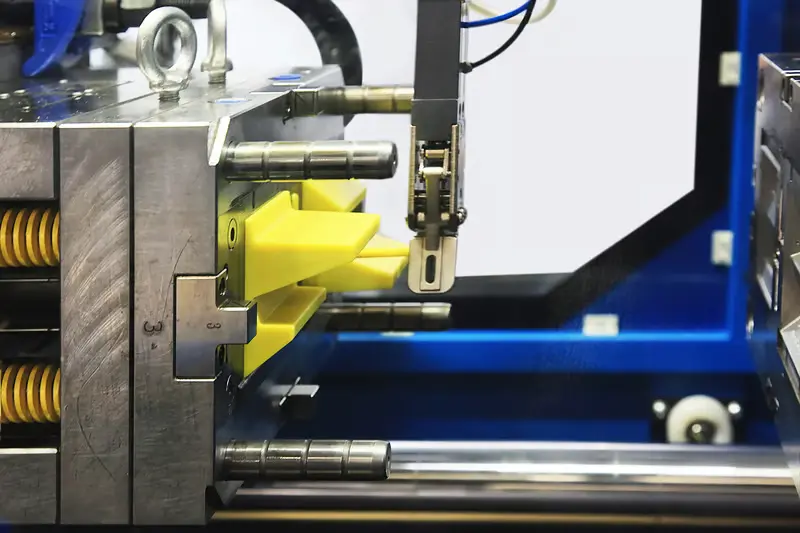
Injection molding machines melt plastic resin and inject it into a mold to manufacture solid components in repeatable production cycles. They are commonly rated by clamping force, usually expressed in tons or kilonewtons (kN), which indicates how firmly the machine can hold the mold closed during injection. However, tonnage alone does not determine whether a machine is suitable for a particular job. Buyers must also check shot capacity, injection pressure, screw specifications, mold dimensions, and production requirements.
The right machine balances these specifications with the part design and expected production volume. A machine with excessive clamping force may cost more to purchase and operate, while an undersized machine may struggle to prevent flash or maintain stable production. Understanding the ratings helps manufacturers select equipment that meets actual manufacturing needs.
What Does Tonnage Mean in Injection Molding?
Tonnage refers to the clamping force generated by the machine’s clamping unit. During injection, molten plastic creates pressure inside the mold cavity. That pressure pushes against the mold halves and attempts to separate them. The clamping unit must resist this force to keep the mold securely closed.
For example, a machine rated at 200 tons can generate approximately 200 tons-force of clamping force under its rated conditions. This does not mean the machine can produce only 200 tons of plastic or that it can manufacture any component weighing less than that amount. Tonnage describes the force available to hold the mold closed, not the weight of the finished product.
Why Does Clamping Force Matter?
Insufficient clamping force can allow the mold to open slightly during filling and packing. Molten plastic may escape through the parting line, creating flash. The resulting parts may require trimming or may fail dimensional inspection.
Excessive clamping force is not automatically better. It can increase energy consumption, place unnecessary stress on the mold, and affect venting. The objective is to select enough force for the actual cavity pressure and projected area, with a suitable engineering allowance.
When evaluating injection molding machines, buyers should calculate the required force instead of choosing equipment based only on the size of the finished component.
How Do You Calculate the Required Machine Tonnage?
The basic principle is that clamping force must exceed the force trying to open the mold. That opening force depends mainly on two factors: the total projected area and the pressure inside the mold cavities.
Basic formula:
Required clamping force = Total projected area × Average cavity pressure
The units must be consistent. For a practical metric calculation using projected area in square centimeters and cavity pressure in kgf/cm²:
Clamping force (metric tons-force) = Area (cm²) × Pressure (kgf/cm²) ÷ 1,000
The projected area is the part’s outline viewed in the direction the mold opens. It is not the total surface area of the component. For a multi-cavity mold, calculate the projected area of all cavities and include the relevant runner area, particularly when using a cold runner system.
Worked Tonnage Example
Suppose a manufacturer plans to produce a four-cavity plastic housing. Each cavity has a projected area of 100 cm². The cold runner adds another 40 cm², and the estimated average cavity pressure is 350 kgf/cm².
Total projected area:
(100 × 4) + 40 = 440 cm²
Theoretical clamping force:
440 × 350 ÷ 1,000 = 154 metric tons-force.
If the engineering review applies a 15% allowance, the preliminary requirement becomes approximately 177 metric tons-force. The manufacturer would then compare available machine sizes and select a suitable model above that requirement, provided all other specifications also match.
This is an estimating example, not a universal pressure recommendation. The actual cavity pressure depends on the resin, wall thickness, flow length, gate design, and process conditions. Mold-flow analysis and trials can provide a more reliable selection basis.
What Units Are Used to Measure Injection Molding Machines?
Manufacturers use several measurement systems in machine specifications. Buyers should understand the difference between force, pressure, distance, and capacity units before comparing equipment from different suppliers.
Tons, Metric Tons, and Kilonewtons
Clamping force is commonly stated in tons or metric tons-force. However, the word “ton” can refer to different units.
One metric ton-force is approximately 9.81 kN. One US short ton-force is approximately 8.90 kN. These units are not interchangeable without conversion.
For example, a clamping force of 200 metric tons-force is approximately 1,961 kN. A machine rated at 200 US tons provides approximately 1,779 kN. The difference matters when comparing machines from manufacturers that use different rating conventions.
Always confirm whether a specification refers to metric tons-force, US short tons-force, or kilonewtons. A quotation that simply says “200 tons” is incomplete for a technical comparison.
Pressure, Capacity, and Dimensions
Injection pressure is commonly expressed in megapascals (MPa) or bar. One MPa equals 10 bar. These units describe pressure, not clamping force.
Shot capacity may be shown in grams, cubic centimeters (cm³), or ounces. Some manufacturers state capacity using a reference material such as polystyrene. The actual usable shot weight changes with the density and processing behavior of the selected resin.
Other specifications use millimeters for screw diameter, mold thickness, opening stroke, and tie-bar spacing. Buyers should check the original unit and measurement basis rather than relying on rounded figures in a sales brochure.
Which Specifications Should You Check Before Buying?
Tonnage is only one part of machine selection. A machine may have sufficient clamping force but still be unsuitable because the mold does not fit, the injection unit cannot deliver enough material, or the screw cannot process the selected resin at the required production rate.
Shot Size and Injection Capacity
Shot size describes the amount of molten material the machine can inject in one cycle. The required shot includes the parts and, where applicable, the runner system.
A machine should not normally be selected so that every cycle uses its entire rated shot capacity. The appropriate operating range depends on the machine design, resin, screw, and manufacturer guidance. Running too close to the machine’s limits can restrict process flexibility, while an excessively large injection unit may make small shots difficult to control.
When comparing injection molding machines, check whether the quoted shot weight is based on polystyrene or another reference material. A figure in grams cannot always be compared directly across machines without checking the reference resin and test conditions.
Injection Pressure and Injection Speed
Injection pressure determines the force available to push molten material through the nozzle, runner, gate, and cavity. Injection speed indicates how quickly the material can be delivered.
Thin-wall components, long flow paths, and complex geometries may require higher injection speeds or pressure capability. A machine that has sufficient tonnage but inadequate injection performance may produce short shots or inconsistent filling.
Do not confuse maximum machine injection pressure with actual cavity pressure. Pressure is lost as material moves through the machine nozzle and mold feed system. The pressure experienced inside the cavity is influenced by the entire flow path.
Screw Diameter and Plasticizing Capacity
The screw melts, mixes, and transports the polymer before injection. Screw diameter affects shot volume, injection characteristics, and the pressure available for a given machine configuration.
Plasticizing capacity indicates how quickly the machine can prepare molten material. This becomes important in high-volume production, especially when cycle times are short or shot sizes are large.
The correct screw should suit the resin and production target. Glass-filled polymers, heat-sensitive materials, and engineering plastics may require particular screw designs or processing controls. A general-purpose screw may not deliver the best results for every application.
Mold Size and Machine Dimensions
The mold must physically fit between the machine’s platens and tie bars. Buyers should check tie-bar spacing, platen dimensions, minimum and maximum mold thickness, opening stroke, and ejector stroke.
Mold weight and mounting requirements also matter. A machine may have enough clamping force but lack the space or mechanical capacity to accommodate a large tool.
These checks should happen before purchase, not after delivery. Confirm the mold drawing against the machine manufacturer’s complete installation specifications.
What Types of Injection Molding Machines Are Available?
Machine design affects energy use, maintenance, control, and suitability for different production environments. The main categories include hydraulic, all-electric, and hybrid machines.
Hydraulic Machines
Hydraulic machines use fluid power to operate the clamping and injection systems. They are widely used in general manufacturing and can provide high clamping force for large components.
Their strengths include established technology, broad availability, and suitability for demanding applications. However, energy consumption, hydraulic oil management, heat generation, and maintenance requirements need consideration. Modern variable-pump and servo-hydraulic systems can improve efficiency compared with older fixed-pump designs.
All-Electric Machines
All-electric machines use servo motors to control key movements. They are often selected for applications that need precise repeatability, clean operation, and controlled movement.
They can be attractive for medical components, electronic parts, and other products with demanding process requirements. Their purchase price may be higher, and the suitability of the available model should be checked against the required clamping force, shot size, and application.
Hybrid Machines
Hybrid machines combine hydraulic and electric technologies. For example, a manufacturer may use electric drives for injection or metering and hydraulic power for clamping.
The purpose is to balance performance, energy use, and investment cost. The best option depends on the application, expected machine hours, maintenance capability, and local service support.
How Do You Choose the Right Machine for Your Production?
A reliable selection starts with the mold and part requirements, not the machine brochure. First, confirm the material, number of cavities, projected area, expected cavity pressure, and shot weight. Calculate the preliminary clamping force and compare it with available machine ratings.
Next, check the injection unit. The machine needs sufficient shot capacity, injection pressure, injection speed, and plasticizing output for the material and cycle target. Confirm that the screw and barrel are appropriate for the resin.
Then review physical compatibility. Tie-bar spacing, platen size, mold thickness, opening stroke, ejector stroke, and mold weight must all meet the tooling requirements. If any of these limits are exceeded, the machine may not be usable even when its tonnage appears suitable.
Finally, consider the production environment. Compare energy consumption, expected cycle time, maintenance requirements, operator experience, spare parts availability, and after-sales service. A machine with a lower purchase price may become more expensive if it consumes more energy or causes frequent production interruptions.
A practical approach is to request a machine-mold compatibility review from the supplier or mold maker. Provide the part drawing, resin grade, mold layout, shot weight, and expected cycle time. This allows the technical team to assess the complete application rather than recommend a machine based on tonnage alone.
Common Machine Selection Mistakes to Avoid
One common mistake is buying the largest machine the budget allows. Oversizing can increase equipment cost and energy use without improving the product. It may also create an unsuitable match between the injection unit and the required shot size.
Another mistake is comparing machines using tonnage alone. Two machines with similar clamping force can have very different injection pressures, screw diameters, shot capacities, and mold space. Buyers should compare complete specification sheets.
A third mistake is overlooking the material reference used for shot capacity. A machine’s stated maximum shot weight may be based on a resin that behaves differently from the production material. Always confirm capacity using the intended polymer and machine configuration.
The final mistake is ignoring service and maintenance. Production reliability depends on more than the original purchase. Local technical support, spare parts, preventive maintenance, and operator training can have a direct effect on the total cost of ownership.
Conclusion
Choosing the right injection molding machines requires more than matching a mold to a tonnage rating. Clamping force must be calculated from projected area and cavity pressure, while shot capacity, injection performance, screw design, mold dimensions, and production volume must also be checked.
Buyers should compare units carefully, verify machine specifications with the mold drawing, and consider the long-term cost of operation. A properly matched machine supports stable production, reduces avoidable defects, and helps manufacturers meet quality and output targets without paying for unnecessary capacity.
FAQs
1. How do I calculate the tonnage needed for an injection molding machine?
Multiply the total projected area of the cavities and relevant runners by the estimated cavity pressure. Convert the result into the required force unit and apply an engineering allowance based on the material, mold design, and process conditions. Confirm the estimate with the mold maker.
2. What is the difference between metric tons and US tons in injection molding?
A metric ton-force equals approximately 9.81 kN, while a US short ton-force equals approximately 8.90 kN. Therefore, machines with the same numerical tonnage rating may provide different clamping forces. Always check the unit stated in the manufacturer’s technical specification.
3. Does higher tonnage mean a better injection molding machine?
No. Higher tonnage only means greater clamping force. A suitable machine must also provide the required shot capacity, injection pressure, speed, plasticizing output, and mold dimensions. Oversized equipment can increase purchase and operating costs without improving production quality.
4. What is shot capacity in an injection molding machine?
Shot capacity is the amount of molten plastic that the injection unit can deliver during one cycle. Manufacturers may express it in grams, cubic centimeters, or ounces. Check the reference material used for the rating because actual shot weight varies with resin density.
5. What specifications should I compare when buying an injection molding machine?
Compare clamping force, shot capacity, injection pressure, injection speed, screw diameter, plasticizing capacity, tie-bar spacing, platen size, mold thickness range, and opening stroke. Also review energy use, maintenance needs, control features, service support, and compatibility with your production material.